|
| |
Dear readers,
We are pleased to share the December issue of the European Bioplastics Bulletin with you, containing the latest news and insights from the bioplastics industry.
If you have any questions, comments, or interesting news or topics to share, please do not hesitate to contact us.
Enjoy the read!
Kind regards from the European Bioplastics team
|
|
|
|
| |
Global market for bioplastics to grow by 20 percent
The results of European Bioplastics’ annual market data update 2017 confirm a stable growth of the global bioplastics industry. The global market for bioplastics is predicted to grow by 20 percent over the next five years. The global bioplastics production capacity is set to increase from around 2.05 million tonnes in 2017 to approximately 2.44 million tonnes in 2022. "The transition to a low-carbon and circular economy, stronger policy support for the bioeconomy, and an increased consumer awareness for sustainable products and packaging are driving the expansion", says François de Bie, Chairman of European Bioplastics.
|
|
|
|
|
| |
PLA in the waste stream
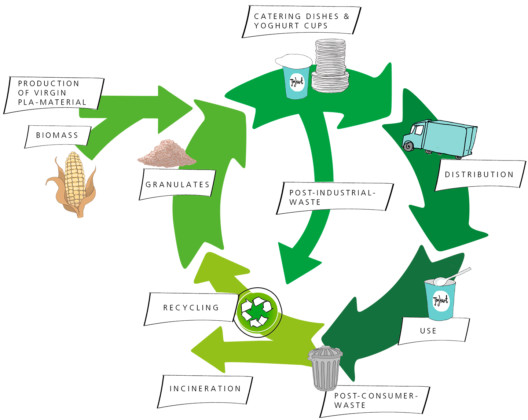
The new German packaging law includes provisions under which the participation fees for packaging shall incentivise the use of recycled and renewable materials. The consequential increase in bio-based plastic packaging and the expected rise of new types of materials entering the recycling streams led the German Ministry of Food and Agriculture (BMEL) to initiate a study on the disposal, sorting, and recycling of bio-based plastics. A research alliance generated post-consumer as well as industrial waste containing PLA and tested the feasibility of material and feedstock recycling processes accompanied by life cycle assessments. The following findings are a summary of the results of these tests.
|
|
|
|
|
| |
Cascading Materials Vision: Extending the life of our natural resources
Secondary materials – those that have already been used at least once in some form – could fundamentally change the way we manage our waste and materials usage. But there are still many systemic barriers that make the acquisition and use of more secondary materials difficult. The World Wildlife Fund (WWF) saw the potential in this area and created the Cascading Material Vision in partnership with the world’s leading brands, policy-maker, materials, management solution providers and environmental non-profits.
|
|
|
|
|
| |
Member portrait: JinHui ZhaoLong
In each issue of the Bioplastics Bulletin, we present 5 facts about a member of European Bioplastics. This month, Janice Li, CEO of JinHui ZhaoLong shares some information on one of the leading producers of biodegradable plastics in China.
|
|
|
|
|
| |
Bioplastics are making the difference
The 12th edition of the European Bioplastics Conference took place on 28/29 November 2017 in Berlin. It was yet another successful meeting of the industry with over 330 participants from 200 companies and 30 countries connecting and catching up on the latest developments and trends in the bioplastics industry in Europe. In his opening speech, François de Bie, Chairman of European Bioplastics (EUBP), the organiser of the conference, said: “Europe is a world leader in developing and commercialising innovative biopolymers. Many of the pioneers in the industry are expanding their existing production capacities. They are responding to the increased demand for innovative and sustainable biopolymers by brands and consumers alike.”
|
|
|
|
|
| |
News in brief
- Mazda and Mitsubishi Chemical develop bio-based engineering plastic grade
- OK compost certification now part of TÜV AUSTRIA Group
- Novamont doubles production of biopolyesters
- Map of 224 European biorefineries published by BIC and nova-Institute
|
|
|
|
| |
Impressum |
|
European Bioplastics
Marienstr. 19-20
10117 Berlin
|
|
|
|
|
|