

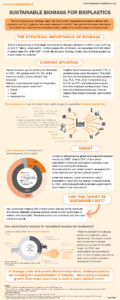
Sustainable Biomass for Bioplastics
Biobased plastics remain a strategic pillar of Europe’s Bioeconomy vision and help in decoupling economic growth from fossil resources, building a more resilient Union.
-
The EU’s Bioeconomy Strategy vision for 2040 envisages that products such as sustainable biobased plastics would be widely used in the EU, playing a role in defossilisation and in the creation of new stable income streams in Europe.
-
Biomass is strategically important for the EU’s bioeconomy, and biobased plastics help to reduce reliance on fossil resources.
-
Biobased plastics can be sustainably produced from a wide range of renewable feedstocks, of which starch, sugar, and vegetable oils are very important for the biobased plastics and chemicals sector.
-
In 2023, only ~5.5% of the European chemical sector’s carbon demand was biobased.
-
To defossilise the global chemicals and materials industry by 2050, the biobased carbon embedded in chemicals and derived materials (including biobased plastics) would need to grow significantly. It is considered that such required growth targets can be sustainably met.
-
Land use impact for biobased plastics will remain minimal despite such a significant growth requirement.