Guidelines for the use of the Seedling logo

Open the document The Seedling logo is a registered trademark owned by European Bioplastics. It proves that a product is certified industrially compostable according to the European standard EN 13432. When successfully certified, the product is compostable in an industrial composting plant under controlled conditions such as temperature, moisture and time frame – [...]

Two new team members in the Brussels office

The open house day of June 5 was the occasion to officially introduce the new EUBP staff members, Julie Pieters, EU Policy Affairs Officer, and Marion Thérage, Communications Manager, who both joined the team on 1 May. They joined the Brussels office, led by Roberto Ferrigno, Head of EU Affairs, since 1 February 2023. [...]

2023-10-19T10:39:10+02:0010 July 2023|Tags: , , , , |

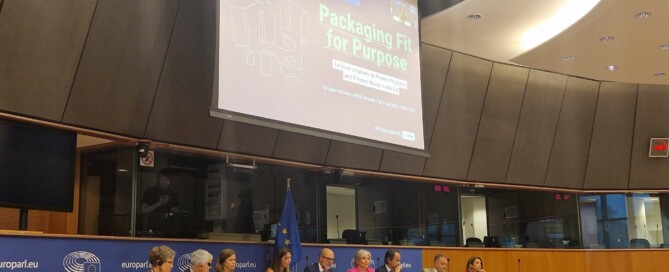
PPWR: Where are we at now?

Second from right, Roberto Ferrigno, Head of Public Affairs at EUBP The Packaging and Packaging Waste Regulation (PPWR) has been a very important file for a lot of industries, and the polymers industry in particular, as a lot of packaging is indeed today made of plastics. It is with no surprise that [...]

RCI study debunking competition between food and feedstock

A new publication by the Renewable Carbon Initiative challenges the commonly held belief that using food and feed crops for bio-based materials is detrimental to food security. Against the backdrop of a global hunger crisis, the paper argues that the biomass debate is flawed, subjective, and lacks sufficient evidence. It suggests that other factors [...]

Member Portrait: Coexpan

Walter Turci, Innotech Director and Coexpan R&D Director Every month, we present 5 facts about a member of European Bioplastics. This time, Walter Turci, Innotech Director and Coexpan R&D Director, shares some interesting insights on his company. 5 facts about Coexpan, Spain Coexpan, the rigid packaging business unit of Grupo Lantero, is [...]

Open house in Brussels

The Brussels office officially opened its doors to the public on 5 June for its open-house day. Members, staff, fellow trade associations as well as EU officials were present to discover the Brussels office, and network on a sunny Monday afternoon.   For the occasion, the office was decorated in orange and white, celebrating [...]

2023-07-10T16:53:16+02:0010 July 2023|Tags: , |

HARMONITOR survey on sustainability certification

HARMONITOR is conducting a survey on the effectiveness and robustness of sustainability certification schemes and labels (CSL’s) that have been integrated in the supply chains of biobased products in the EU. The objective of the survey is to inform on the potential and challenges for these certifications to become a co-regulation policy instrument in [...]

2023-07-10T14:03:39+02:0010 July 2023|Tags: , , , , |

Seedling certification scheme (July 2023)

Open the document Since its foundation in 1993, European Bioplastics (former IBAW) has been committed to the establishment of a legal and technical framework for supporting the introduction of bioplastics to the market. The association is the owner of the Seedling mark, which is protected by trademark law. This mark is widely acknowledged, [...]

Sustainability Framework survey

The BIOPLASTICS-EU project would like to invite you to take part in a survey to explore what impact the current plastic industry may have on sustainability, and what opportunities can be explored in the future.   This study contributes to a larger project “BIO-PLASTICS Europe”, led by Professor Walter Leal (Project Coordinator) at HAW Hamburg, [...]

2023-06-01T13:48:53+02:001 June 2023|Tags: , , , |

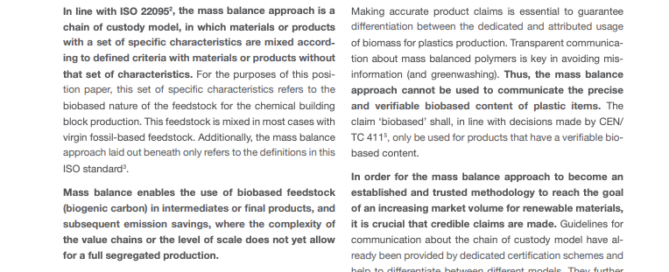
We need a clear distinction in the communication about the use of verifiable renewable feedstock and “bio-attributed” feedstocks using mass balance 

Traditional polymer manufacturing processes heavily rely on fossil fuels as feedstock, contributing to greenhouse gas emissions and the depletion of finite resources.   The utilisation of biomass in the plastics sector has evolved to offer sustainable alternatives to conventional fossil-based materials. By leveraging biogenic feedstock, the industry can reduce its environmental impact and promote circularity. [...]

Go to Top